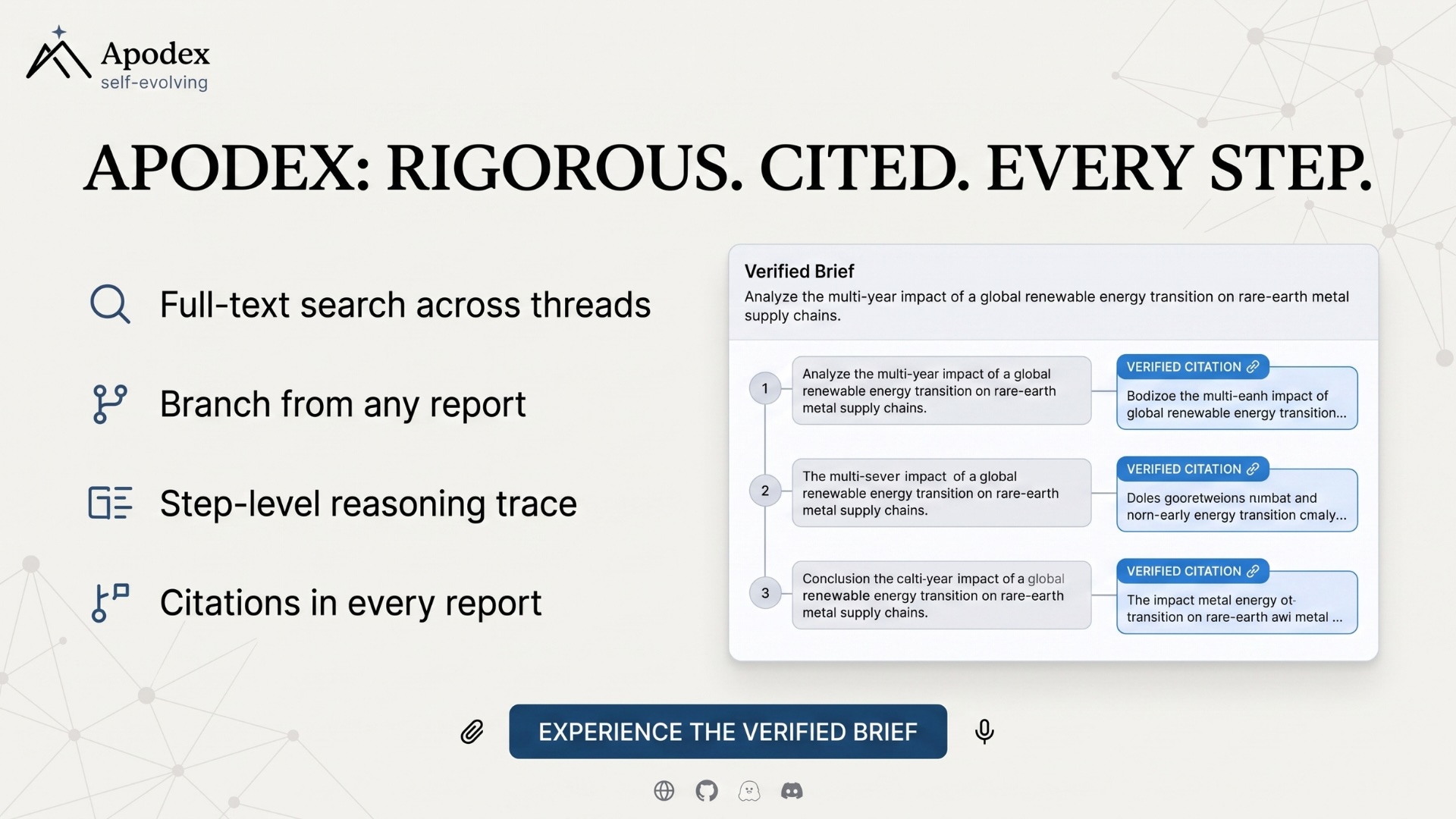
Apodex AI officially launched Apodex 1.1, a significant step forward in building what the company calls a “Self-Evolving Heavy-Duty Solver.” This release moves beyond traditional deep-research agents that primarily synthesize reports and instead focuses on —the ability to make sustained, verifiable progress on long-horizon, real-world objectives.
In an AI landscape crowded with ever-larger models and flashy demos, Apodex is doubling down on something more practical and ambitious: systems that can decompose complex tasks, coordinate teams of specialized agents, interact with files and code environments, recover from failures, and deliver inspectable results. The company positions this as progress toward “discoverative intelligence”—AI that doesn’t just recombine existing knowledge but helps push into genuinely hard problems in science, finance, professional workflows, and beyond.
Apodex 1.0, released in June 2026, already stood out with its verification-centric design. A single trained model could run as a standard ReAct agent, while a “heavy-duty” mode spun up asynchronous agent teams with independent verifiers that audited evidence before committing answers. That system set strong results on deep-research benchmarks.
Version 1.1 expands the ambition. The team frames the core challenge clearly: modern language models reason and synthesize well, yet many valuable tasks still fail because the work unfolds over days or weeks. Agents must handle heterogeneous files (PDFs, spreadsheets, experimental data, images), execute and debug code, maintain coherent plans across hundreds of steps, revise when new observations arrive, and produce deliverables another human can actually use or continue.
Apodex operationalizes this as working capability and attacks it along two complementary scaling surfaces:
Both rest on a shared foundation: the AgentOS runtime and execution harness that maintain persistent task state, workspace, provenance, artifacts, and delivery contracts across tools and agents.
The headline feature is the upgraded Agent Team mode (sometimes referred to in the context of Deep Discover workflows). A lead agent reasons over the full problem, dynamically decomposes it, and spawns specialized sub-agents on demand—rather than relying on a fixed catalog of roles. These sub-agents work in parallel on evidence gathering, analysis, implementation, verification, and counteranalysis. Findings flow into a persistent task board or shared evidence pool. Results integrate asynchronously, and humans can intervene mid-run to steer the process without discarding valid progress.
Key enhancements in 1.1 include:
A simpler single-agent ReAct mode remains available for focused work. Across benchmarks evaluated in both configurations, Agent Team consistently delivered gains of 4.1–9.3 points.
Apodex reports that the full 1.1 system (especially in Agent Team mode) reaches the leading performance band on several professional, financial, and scientific evaluations while remaining competitive on general reasoning, search, mathematics, and coding—often with a substantially smaller model footprint than many frontier systems. Highlighted numbers include:
The open-weight Apodex 1.1 mini (approximately 35B parameters) is particularly notable for efficiency. In Agent Team mode it scores around 50.2 on FrontierFinance, 51.7 on FrontierScience-Research, and 27.7 on APEX-Agents—competitive with much larger models on overlapping tasks and a clear improvement over the previous mini version.
These figures come from Apodex’s technical report and official announcements; independent third-party verification will take time as the open components become more widely tested.
Apodex is releasing substantial open components alongside the closed frontier model:
The full Apodex 1.1 model is available through the online workbench at apodex.ai and the API platform. A Frontier Program offers higher-intensity access for selected research groups.
Most current agent systems excel at short loops or generating polished reports. Apodex 1.1 pushes harder on the harder problem: keeping coherent, recoverable state across long, messy trajectories while verifying claims independently. The emphasis on executable environments and coordination scaling feels like a pragmatic path toward systems that can actually finish complex professional or scientific work rather than merely describe how it might be done.
Whether Apodex fully delivers on the “Heavy-Duty Solver” vision will depend on real-world adoption, the robustness of the open harness, and how the models perform outside carefully constructed benchmarks. Still, the release is one of the clearer signals yet that the next phase of agentic AI will be measured less by single-turn cleverness and more by sustained, auditable progress on problems that matter.
Try it: Live workbench and API via apodex.ai / platform.apodex.ai. Open weights and FrontierAgent on Hugging Face and GitHub (ApodexAI/FrontierAgent). The technical report “Apodex 1.1: Scaling Agentic Intelligence for Complex Work” provides the full details.
The race to build AI that can reliably do hard, long-running work is accelerating—and Apodex just raised the stakes.