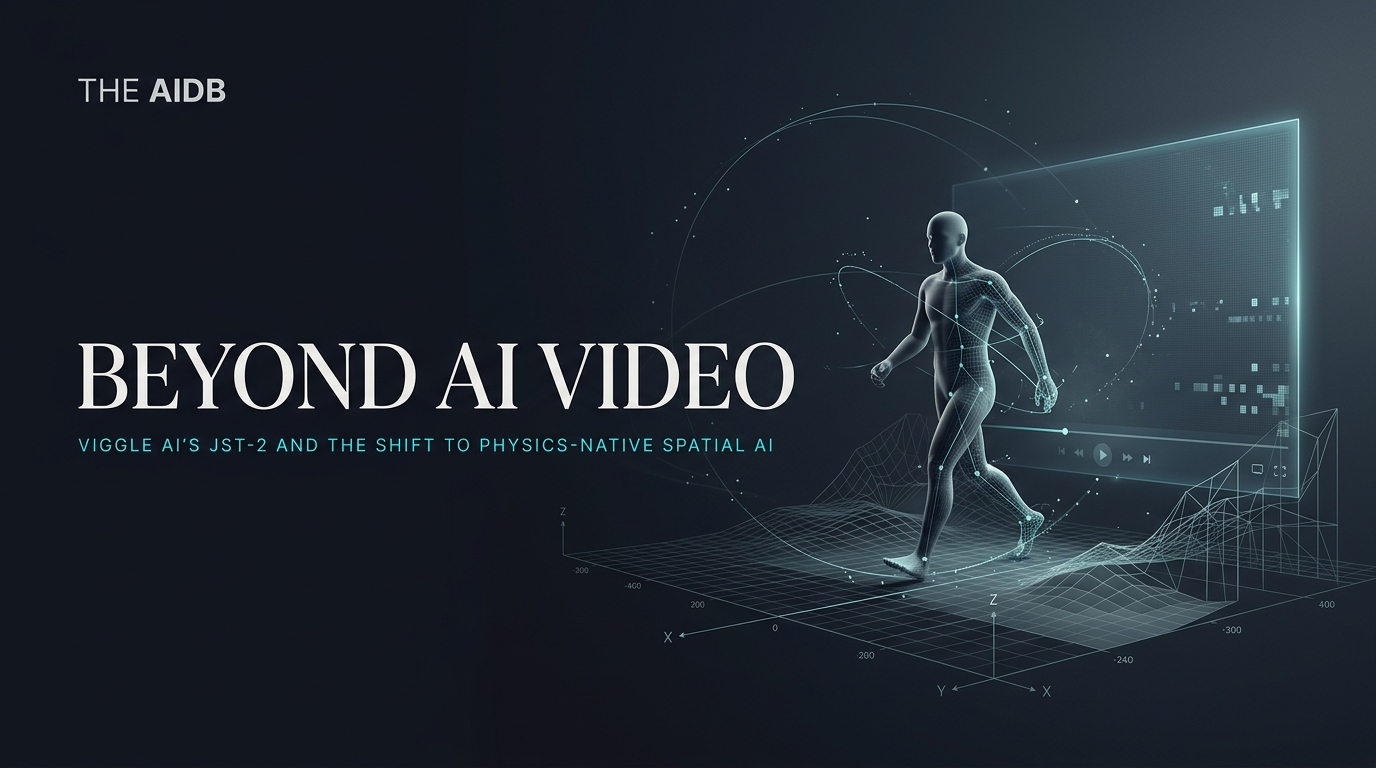
Viggle AI is pushing generative AI beyond video creation with its Joint Space-Time technology, designed to bring characters, motion, and 3D environments into a shared spatial representation.
Generative AI has become increasingly capable of producing realistic images and videos. But creating a convincing sequence of frames is different from generating a three-dimensional environment in which characters and objects can move consistently.
That distinction is central to Viggle AI's JST-2 technology.
The company is positioning its physics-native approach as a step toward a new category of spatial generative AI—systems that create and manipulate characters, motion, and environments rather than simply producing finished video clips.
Most AI video generators produce visual frames that appear to depict motion. While increasingly sophisticated, their outputs do not necessarily contain a reusable 3D representation of the environment being shown.
Viggle is pursuing a different architecture.
Its proprietary Joint Space-Time (JST) model is designed around the relationship between spatial structure and motion, helping AI-generated characters behave more consistently within a scene.
The broader ambition is to combine 3D environments, characters, and movement in a shared representation that could support interactive experiences.
For game developers, animators, and simulation researchers, this represents a potentially important evolution: AI-generated content that can be manipulated and incorporated into production workflows.
JST-2 belongs to Viggle's Joint Space-Time model family, which underpins its approach to physics-aware character animation and spatial generation.
Instead of focusing exclusively on what an image should look like, the technology attempts to incorporate information about how characters occupy space and how their movements should behave.
This approach is particularly relevant to three capabilities:
1. 3D character creation
Viggle's PINOC platform can reconstruct a 3D character representation from an image, allowing creators to preview movement on characters based on their own visual designs.
2. AI-generated motion
The platform supports converting recorded video into skeletal animation and generating movements from text descriptions.
This can reduce the need for traditional motion-capture equipment during early-stage production.
3. Spatially aware animation
By incorporating physical priors into its models, Viggle aims to produce motion that better accounts for properties such as weight, timing, and ground contact.
Together, these capabilities provide a foundation for more controllable AI-generated experiences.
One persistent challenge in generative video is physical consistency.
A model might generate an impressive-looking character jumping, running, or interacting with a scene without maintaining realistic weight distribution, spatial relationships, or contact with surrounding surfaces.
Physics-aware representations could help address some of those weaknesses.
For example, a virtual character should appear to maintain contact with the ground while walking. Its movements should also reflect believable transitions between acceleration, stopping, and changes in direction.
Viggle's approach attempts to incorporate this kind of information into the generation process.
However, physics-aware animation should not be confused with a complete physics simulator. Generating plausible movements does not automatically mean a system can accurately predict every collision, material interaction, or physical consequence.
The implications extend beyond AI-generated social media videos.
For game development, these systems could accelerate character prototyping, background-character animation, and the development of motion assets.
For animation studios, they could reduce repetitive production work, particularly when testing movement sequences and early scene concepts.
For interactive media, spatially consistent AI representations could eventually make personalized experiences easier to create.
And for robotics and physical AI research, world models are attracting attention because they offer a potential way to represent, predict, and simulate aspects of real-world environments.
Viggle's technology should not yet be regarded as a replacement for game engines or industrial simulation systems. Nevertheless, it illustrates how the boundaries between content generation and interactive 3D creation are becoming less distinct.
Viggle is entering a research field that includes major AI companies.
Google DeepMind has demonstrated action-controllable virtual environments through its Genie research, while NVIDIA's Cosmos platform provides world foundation models intended to support physical AI development.
These approaches differ in their architectures, applications, and maturity.
What they share is an interest in moving beyond static content generation toward systems that can represent how environments change and respond to actions.
Viggle's emphasis on character creation, animation, and creator-facing production tools gives it a distinct practical focus.
The immediate test for Viggle will be how well its technology performs in real production environments.
Important questions include whether generated assets remain consistent, how easily developers can integrate them into existing workflows, and whether physics-aware behavior generalizes to increasingly complicated scenes.
Independent evaluations will also matter, particularly when comparing the technology with established animation tools and emerging world-model systems.
For now, Viggle's Joint Space-Time technology demonstrates a potentially important direction for spatial generative AI.
The bigger opportunity is not simply producing more realistic AI videos. It is creating reusable digital characters, movements, and environments that can become building blocks for interactive experiences.
As generative AI evolves, the next competitive frontier may be less about what AI can show us—and more about the worlds it can help us create and manipulate.
Learn more: Viggle AI | Viggle PINOC
Source note: This article draws on Viggle's published descriptions of its JST technology and PINOC capabilities, alongside Google DeepMind's Genie research and NVIDIA's Cosmos announcement. Specific JST-2 launch performance claims have not been independently verified.